| Professor
Berkeley Law School & University of California at Berkeley Voice: (510) 642-6775 |
 |
Pamela Samuelson is recognized as a pioneer in digital copyright law, intellectual property, cyberlaw and information policy. She has written and spoken extensively about the challenges that new information technologies are posing for public policy and traditional legal regimes. Since 1996, she has held a joint appointment with the Berkeley Law School and the School of Information. She is the director of the Berkeley Center for Law & Technology, serves on the board of directors of the Electronic Frontier Foundation and the Electronic Privacy Information Center, and on advisory boards for the Public Knowledge, and the Berkeley Center for New Media. She is also an advisor for the Samuelson Law, Technology and Public Policy Clinic. Since 2002, she has also been an honorary professor at the University of Amsterdam.
Most recent ones and the first one here
40) "Why the Google Book Settlement Failed - and What Comes Next?", forthcoming in Communications of the ACM, November 2011
This column explains why Judge Chin disapproved the GBS settlement and why the fair use issue may not be decided by the courts. It discusses the possibility of a new settlement and of legislation as alternatives.39) "Pamela Samuelson on codifying the Google Books settlement", podcast at Surprisingly Free, June 28, 2011
Pamela Samuelson discusses "Legislative Alternatives to the Google Book Settlement", her new article in the Columbia Journal of Law & the Arts. Samuelson discusses the settlement, which was ultimately rejected, and highlights what she deems to be positive aspects. One aspect includes making out-of-print works available to a broad audience while keeping transaction costs low. Samuelson suggests encompassing these aspects into legislative reform. The goal of such reform would strike a balance that benefits rights holders, as well as the general public, while generating competition through implementation of a licensing scheme..38) "Overcoming Copyright Obstacles in a Post-Google Book Settlement World", Center for Democracy &Technology, June 15, 2011
Pamela Samuelson provides an overview of "Legislative Alternatives to the Google Book Settlement", her new article in the Columbia Journal of Law & the Arts.37) "Legislative Alternatives to the Google Book Settlement", forthcoming in 34 Columbia Journal of Law & the Arts, (2011)
Now that the court has disapproved the Google Book settlement, it is time to consider the component elements of a legislative package that would achieve most of the social benefits that would have flowed from approval of the settlement without the social harms that the settlement would have brought about. This article is principally focused on how to enable the creation of a digital library of out-of-print books that could be made available to the public on reasonable terms.36) "Google Book Settlement as Copyright Reform", forthcoming in Wisconsin Law Review, (2011)
Certain features of U.S. law, particularly copyright law, contributed to Google's willingness to undertake the Google Book Search (GBS) project in the first place and later to its motivation to settle the lawsuit charging Google with copyright infringement for scanning in-copyright books. Approval of this settlement would have achieved several copyright reforms that Congress might find difficult to accomplish, some of which would be in the public interest. The Article considers whether the quasi-legislative nature of the GBS settlement was merely an interesting side effect of the agreement or a reason in favor of or against approval of this settlement.34) "Why the Google Book Settlement Failed - And What Comes Next?", Dean's Lecture at UC Berkeley School of Information, April 13, 2011
More than a year after the Google Book Settlement fairness hearing, Judge Chin ruled that the settlement was not fair and could not be approved. This talk will explain why I think the failure of this settlement was inevitable. It will also discuss the options available after the failure of the settlement and why some of these options are more likely or desirable than others.1) "The Dead Souls of the Google Booksearch Settlement", O'Reilly Radar, April 17, 2009 (pre-print from Communications of the ACM, July 2009)
The Book Search agreement under consideration is not really a settlement of a dispute over whether scanning books to index them is fair use. It is a massive restructuring of the book industry's future without meaningful government oversight. The market for digitized orphan books could be competitive, but will not be if this settlement is approved in its current form without modification.
- Law 276.1/Infosys 235 : Cyberlaw/Legal Issues in Information Management
- InfoSys 204: Information Users and Society
- InfoSys 296A-2: Intellectual Property and the Future of the Information Society
- InfoSys
296A-3: Economics of Intellectual Property for the Information Age
- Infosys 204: Information Users and Society
- Infosys 296A (section 2): Future of the Information Society, Copyright & Community
- Law 276: Cyberlaw
- Infosys 290 (section 1): Intellectual Property Rights
Fall 2009 Fall 2008 Spring 2008 Spring 2007 Fall 2006 Fall 2005 Spring 2005 Fall 2003 Fall 2002Fall 2001 Fall 2000 Spring 2000 Fall 1999 Spring 1999
Fall 1998 Spring 1998 Fall 1997
Spring 1997
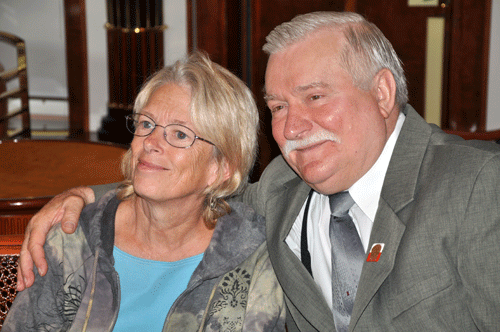
Pam Samuelson with Former Polish President Lech Walesa (July 2009)
 |
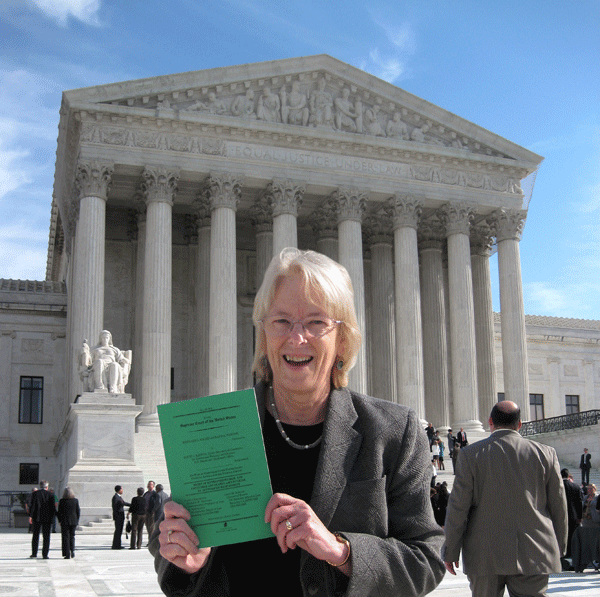
Pamela Samuelson at US Supreme Court with Bilski Brief (November 2009)
 |